Sunday, April 11, 2010

Reflection on principles of communication / teamwork on programming and problem-solution projects

Throughout this semester, we have been divided in groups to discuss tasks set by our tutors. This has led to an increase in chances to hone our teamwork and communication skills. I, for one, know that I have definitely benefited from all these experiences.

The CG1102 group consists of three people. Michael and Anuj were my team mates for this project and we have had to work very closely with one another to finish the labs set for us. After countless meetings, I hope we are all able to say it was a great learning opportunity. This module has not only taught me how to accommodate people with different work habits as me, but also that being in a team provides friends you can count on when you run into difficulties.

Programming in teams in a very interesting way to teach the importance of communication and teamwork. It is such a versatile tool, as n number of people, when given the same programming homework, will almost definitely come up with n different versions of a program which will all do the exact same task. Perhaps some more efficiently than others, but all working nonetheless. This is therefore an added difficulty (on top of simply completing the labs) to agree upon a single structure. Further modifications which had to be done were easier to implement, since the most important part (the skeleton) was already in place. Personally, I believe that within the CG1102 teams, teamwork was a more significant factor in ensuring the success of the project than effective communication. This, in no way, diminishes the importance of effective communication, but when working on projects, teamwork is key.

The assignments for CG1413 have a different purpose, or rather, a different focus. Blog posts are basically our thoughts. When we write them, we are trying to convey a message to the readers. A message which must accurately inform of our ideas and opinions. This is where communication appears to be the 'star'. By writing down reflections, and also commenting on posts done by my group mates, I have been constantly reminded to practice the 7Cs. Although so many reflections to write can be a little depressing, I know I have learnt more about myself. The posts and comments done by the other members of the class have also revealed points about me that I would never have seen on my own.

Oral presentation is a product of many days of discussions. I had not done presentations for a long time before this semester, and had already lost touch with many skills which make an effective speaker. Working with my classmates, along with their feedback, I'm happy to say I have made improvements and gained confidence in speaking to an audience.

This course has indeed been highly enjoyable, and I would like to thank Ms Brenda as well as my group mates for all the valuable advice you have given me. :) Cheers to all and good luck for exams :P

Sunday, March 28, 2010

Reflection on Oral Presentation 2

We had our second oral presentation on 25th March, Thursday. It was about our research regarding the introduction of casinos in Singapore and the potential problems it may cause.

This was done with a different group from the first oral presentation. Although I believe I have improved, I still see many mistakes which I had made in the first presentation surface again for the second round.

The first half of my presentation was about primary research. When showcasing the survey results, I found it difficult to explain what the numbers meant. It was because I had not practiced since our presentation was postponed from Monday. I had forgotten some of my elaboration points and could not fill the gaps in my head, hence becoming very jittery and nervous. However, I was better prepared for the second part of the presentation which involved secondary research on why people gamble, as well as some statistics. These were interesting facts which I found easier to remember and thus I tried to make up for my previous slip up by adding more information during this section. As I became more confident, I relaxed and tried to share my knowledge in the most interesting way possible.

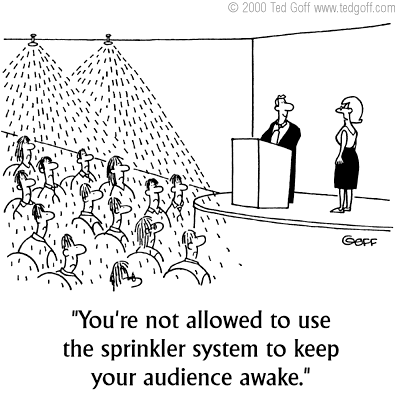
I had written notes for the presentation, but as I had to bend and tap the keyboard to move to the next slide, I felt it was too much of a hassle and so did not refer to them. This helped me give more eye contact to the audience and I could see I had connected with them and they were listening intently to what I had to say. It was very encouraging and so I could keep up my energy and enthusiastic when elaborating my points. This in turn, I hope, kept the audience awake which will then again induce me to keep being interesting. The cycle continues.

During the question and answer session, I was thinking of replies to the inquiries posed by my fellow classmates. However most of the questions were involving the solutions we had come up with for our problem, so I had little to add on to what Andy had answered. I could have better prepared for this section by reading up on what my groupmates had come up with for the solutions. Although I had also prepared a segment, I did not present it and hence I was unsure of how Joon Wai had decided to interpret my points.

As a team, I believe we had done reasonably well. Our slides were prepared separately and thus there were some differences in the style of presentation. We also had individual parts in both primary / secondary research as well as solutions to our problem. There were some problems with arranging the people to present, if we should let each of us present our own parts, or reassign. We had chosen to do a compromise and did a little swapping around so we did not confuse the audience with too many exchanging of presenters. I feel that this arrangement was the best possible choice and had worked out pretty well.

Sunday, February 14, 2010

Reflection on Meeting 1

My group, C05B, held our first meeting on Thursday, 3pm and PGP Project Room. We had chosen to meet on this day as it was the day we were all free for most of the day. It is to ensure we had ample time to prepare for the discussion and so we could have a more fruitful session in the afternoon.

We met together on Wednesday's lab session to get a rough idea on what we were supposed to accomplish during the meeting. We exchanged some pointers on how best to design the program and then went back to think of our separate solutions.

During the filming the next day, it took me some getting used to having a camera pointing in my direction as I gave my suggestions. I believe my team mates also felt uncomfortable at first, but as we went further into the discussion we forgot about the presence of the camera and would lose any shyness involved in the contribution ideas.

As this is a rather long lab, there were many ways to design the program. In this case, we each had a different way of writing out the interface class. The next difficult part was deciding whose design was the best to implement. We started with consolidating the classes which we would use, followed by the required functions. There were some disagreement as to whether we should keep the program short, hence increasing the complexity, or making it detailed and easier to understand, thus reducing the number of problems which might arise from misused commands. However, after much explanation and justification, we decided to go for a slightly more detailed version to help in debugging processes in the future.

We followed the agenda quite closely, ending the meeting in 50 mins. At the end of it all, we decided to meet again the next day to start the coding process, as Michael was going overseas for the mid term break, while Anuj and I had other obligations to fulfill during the week. We also sneaked in a short mention of the report which was due on Sunday, and agreed that we should at least draw up the outline of the codes before we begin the more precise areas of the assignment.

Overall, it was an enjoyable session and we all benefited greatly. This is the first time we were working together to write a single program, and we had quite significant differences in our coding practices. This variety has allowed us the pleasure of choice and of learning about newer and perhaps better ways to do our coding. It is indeed a great learning experience.

Sunday, February 7, 2010

Resolving Interpersonal Conflicts

The following example is based on a strategy game.

A is the founder of a particular team within the stages of gameplay. He has painstakingly recruited a number of singaporean players to join this team in the game, which caters to international play. As founder, he chooses a small number of players to help him run his team.

Before long, A has other real life issues to attend to, and so cannot actively manage the group. The rest of the management team continue to work. However, A retains his position as the founder and requests regular updates on the situation (We all know how addictive online games can be). A has not been playing with the group for a few weeks, but continues to pressure the leadership in giving him regular reports. Unable to cope with his lack of participation and demanding requests, the group, represented by member B, confronts him.

A argues that he was the one who formed the team, hence retaining the right to know all internal workings. B criticises A for being too dictating, and A immediately threatens to delete all the game accounts of the group. Both sides turn sour, A refuses to listens anymore, leaves the group and ends all communication.

You are a mutual friend of both A and B, and you understand how important this game is to both parties, hence why they're so uptight about this. They have both been friends with each other for a long time, and you wish to help them get back on speaking terms. How would you approach this problem?

Sunday, January 31, 2010

Observation of Team Behaviour: Intercultural and Interpersonal Communication

Culture, by popular definition, is the set of shared attitudes, values, goals, and practices that characterizes an institution, organization or group.

My first intercultural interaction was with a Malay family that I used to live next to when I was in kindergarten. They had a girl about my age, and we would frequently play with each other after school. Once, her family invited me over for lunch, and I remember staring at them when I saw they ate with their hands, instead of chopsticks like I did at home. As I was still young I couldn't understand why or how they could possibly hold the hot food with their fingers. Fortunately, they caught my shocked expression and offered me a fork and spoon so I didn’t have to awkwardly attempt to eat with one hand.

It was years after the incident that I learnt it was a part of their culture. This is a prime example of a wide array of cultural differences present in the diverse society of Singapore. Due to the variety of cultures here, it is easy to step over boundaries and cause insult without meaning to. However, it boils down to how you communicate with your friends to understand and prevent such clashes.

As stated in my previous post, teamwork is essential in the progress of any organization. And given the diffusion of the population in the world, there is a great chance that team mates will be of different cultures. Within the teams, diversity can be an asset, as it will help to reach out to a larger group of customers by understanding their needs, and accommodating any restrictions which they may follow. Intercultural communication therefore plays an integral role in building up a better future for the global community.

Sunday, January 24, 2010

Communication and Teamwork

In the fast-paced world of information technology, communication is of utmost importance. Ideas, opinions, innovations, and products are frequent nouns that must be engaged in this field of work, and with them comes the need for effective communication skills. As a student studying for a degree which will land me in this industry, I am almost afraid to say that I'm introverted by nature.

Speaking has never been an easy task for me, and it has led to a more than desirable number of misunderstandings for me. I have always favored myself as a listener, but now I know that listening is not enough. Communication is not a one way road, it also involves feedback where I should reply and express my interpretations of the message which I received. This gives rise to the creation of the 7Cs of communication, guidelines to a successful transmission of the intent of a sender to the receiver.

The importance of communication is further emphasized by another unique characteristic of the IT industry, and that is the existence of teams. Of course, teams are present in many sectors of the economy, and are crucial to the success of any organization. I myself have experienced being a part of a production team in my junior college days. The essence of the team is based highly on the addressing of problems faced logistically, financially and artistically. Only by effectively communicating the nature of the problem, can we work together to find a solution. As everyone has a different way of thinking, a vague order from one can be interpreted in a wide array of ways by another, most of which not even close to the original instructions. Results of which, is total chaos.

Admittedly, communication plays a large role in maintaining a great team. But all talk and no actions will not bring any success. Team members, each and every one of them, must work to their comparative advantage to maximize productivity of the team, or they will be outdone by competitors in the market. This is of great relevance to me again through personal experience and with regards to my future line of work.

Importance of TEAM: Here